
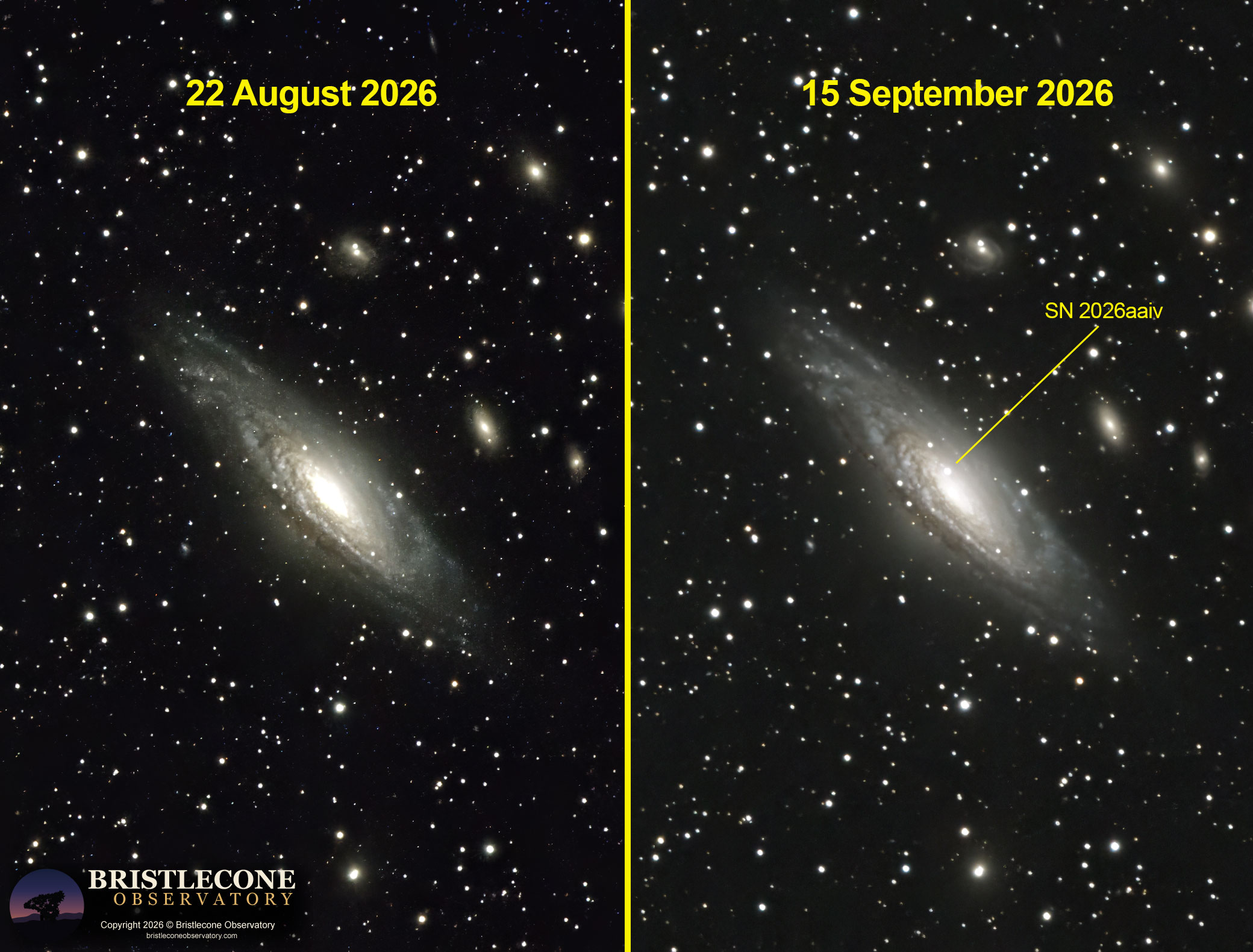
I’ve been reading about a new supernova in NGC7331, and decided to try a quick imaging session around it. When I saved the files, I discovered that I had imaged the same galaxy BEFORE the supernova was found. Attached is a side by side image of the galaxy taken on August 22nd and on September 15th. The yellow line points to the supernova.
NGC 7331 is a spiral galaxy in the constellation Pegasus, about 45 million light years away. It is similar in size, shape and mass to our own Milky Way, which has earned it a reputation as a “Milky Way twin,” and it has long been a favorite target for astrophotographers. William Herschel discovered it in 1784, and it is also listed as Caldwell 30. On September 1, 2026, the ATLAS survey discovered a new supernova, SN 2026aaiv, in NGC 7331, at a magnitude of 15.7. It is a Type Ia supernova, a catastrophic explosion that occurs when a white dwarf in a binary star system gains enough material from its companion to trigger a runaway thermonuclear reaction, destroying the white dwarf. It appeared close to the galaxy’s bright core, and it has since brightened to roughly magnitude 14, within reach of backyard telescopes and even smart telescopes. Remarkably, this is the second supernova in this galaxy in as many years: another Type Ia supernova, SN 2025rbs, was found in the same galaxy on July 14, 2025.