
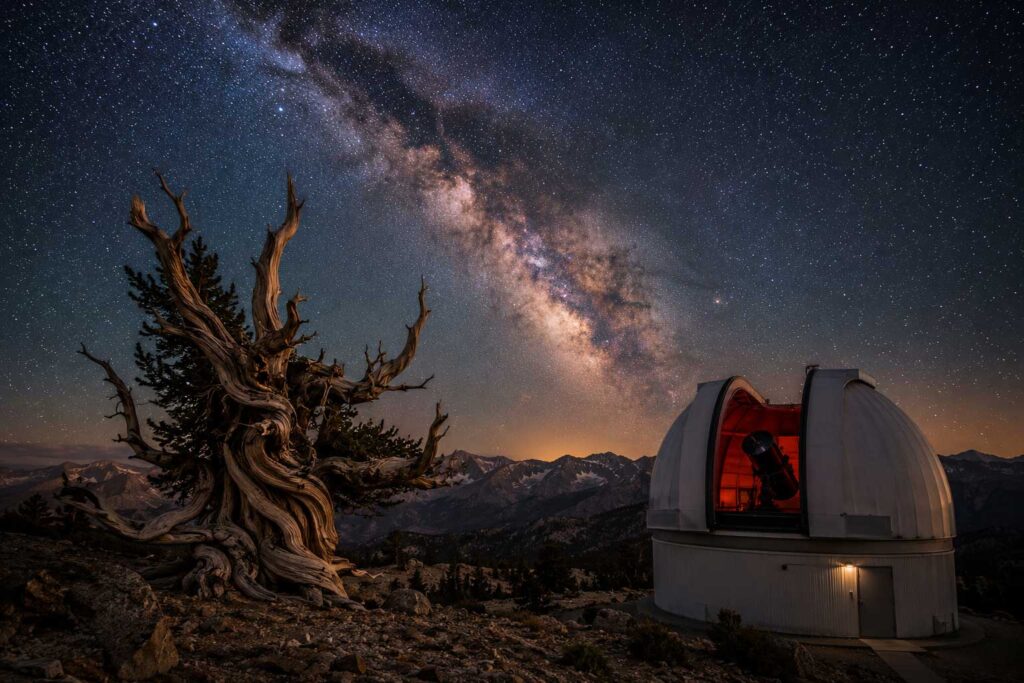
The Bristlecone Pine
Scattered across the high, wind-scoured ridgelines of the Great Basin grows one of the most remarkable living things on Earth: the Great Basin bristlecone pine (Pinus longaeva). These gnarled, wind-sculpted trees are the oldest known non-clonal organisms on the planet — some individuals have been growing for nearly 5,000 years, quietly predating the pyramids of Giza. Their extraordinary longevity comes from the very harshness of where they live: thin, rocky soil, brutal winters, and thin air at high elevation slow their growth to a crawl, and that same slowness produces dense, resin-rich wood that resists rot, insects, and fire for millennia.
Each ring in a bristlecone’s trunk is a record of a single year — a wet season or a drought, a warm year or a cold one — and taken together, these rings form an unbroken climate record stretching back thousands of years. Scientists have used bristlecone tree-ring data to calibrate radiocarbon dating itself, making these trees quietly foundational to how we understand the age of everything else around them. For the Great Basin, the bristlecone is more than a botanical curiosity; it’s a living symbol of endurance in one of the most austere landscapes in North America.
The Observatory
Bristlecone Observatory takes its name from these ancient trees, and shares their high-desert home. Sitting at high altitude within in the Great Basin region, the observatory benefits from the same thin, dry air and remote isolation that has sheltered the bristlecone pines for millennia — conditions that are ideal for observing the night sky as they are for outlasting it. Bortle 1 skies at the observatory rank among the darkest remaining anywhere in the western United States, free from the light pollution that has erased the stars over most of the country.
The observatory itself is purpose-built for astrophotography: a precision equatorial mount, a wide-field refractor, and a cooled astronomy camera, all controlled remotely and automated for unattended imaging runs. Where the bristlecone pine measures time through the rings written into its wood, the observatory measures something similar in an entirely different medium — capturing light that, in many cases, has been traveling for thousands or millions of years before it reaches the sensor. Both are, in their own way, instruments for looking backward through time.