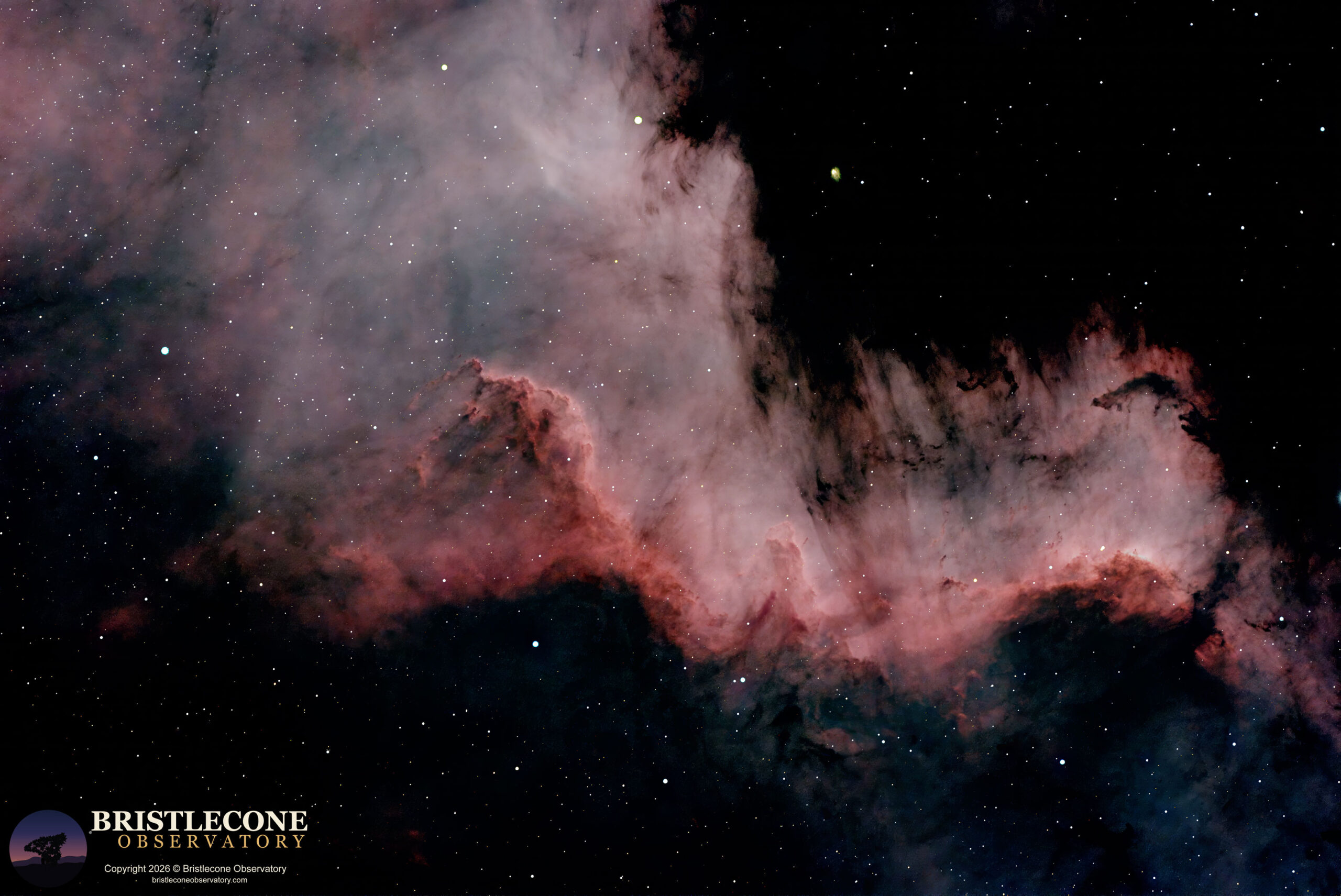
The Cygnus Wall is the brightest and most dramatic region of the North America Nebula (NGC 7000), a vast cloud of glowing hydrogen gas in the constellation Cygnus, about 2,600 light years away. It sits along the “Gulf of Mexico” and “Central America” portion of the nebula’s continent-like outline, which was first noted by William Herschel in 1786. The nebula as a whole spans roughly 100 light years. The Wall is a ridge where hot, ionized gas meets a dense, dark cloud of cool gas and dust. Ultraviolet light from nearby young, massive stars energizes the hydrogen so that it glows its characteristic red, while the dense dust sculpts the edge into towering pillars, ridges and dark filaments. The Wall is also an active stellar nursery, where new stars are forming inside the dense clouds even as the radiation of their siblings slowly erodes the surrounding gas. Together with the neighboring Pelican Nebula (IC 5070), it is part of one of the richest star-forming complexes in the northern sky.