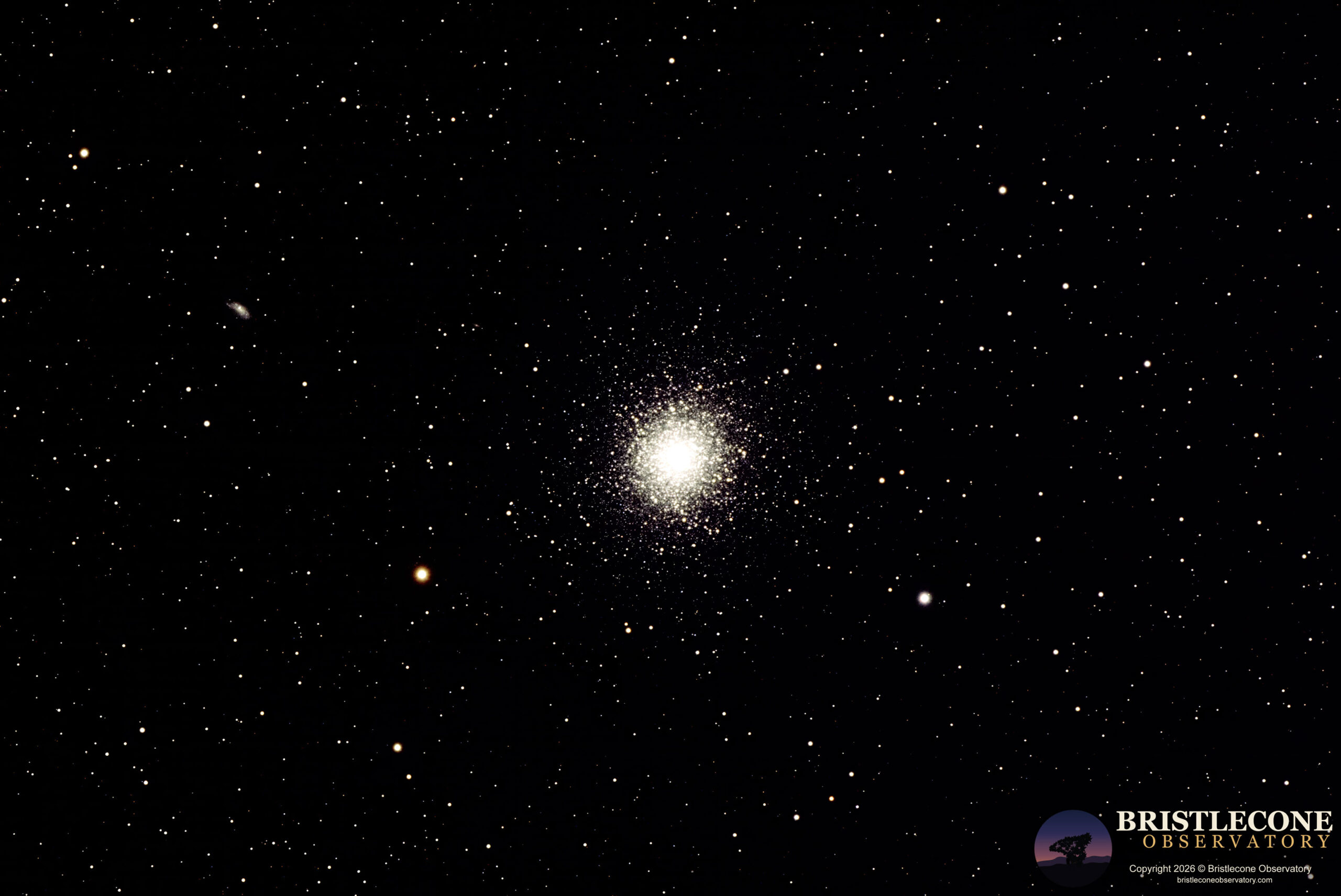
M13, the Great Globular Cluster in Hercules, is a densely packed ball of hundreds of thousands of stars roughly 22,000 light years away. It spans about 150 light years, and its stars are packed so tightly toward the core that the center appears as a blazing white glow. English astronomer Edmond Halley discovered it in 1714, and Charles Messier added it to his catalog in 1764. At around 12 billion years old, M13 is among the oldest objects in the Milky Way, a relic from the early days of the galaxy. It orbits the galactic center in a halo far above the disk, and under very dark skies it can just be seen with the naked eye as a faint, fuzzy star. In 1974, astronomers used the Arecibo radio telescope to beam a brief message toward M13, humanity’s first deliberate attempt to broadcast a signal to the stars. The message will take about 25,000 years to arrive, and the cluster will have drifted by then, so it is unlikely to hit its target. The small galaxy in the upper left of this image is NGC 6207, a spiral roughly 30 million light years away, a reminder of how much farther the universe extends beyond our own galactic neighborhood.