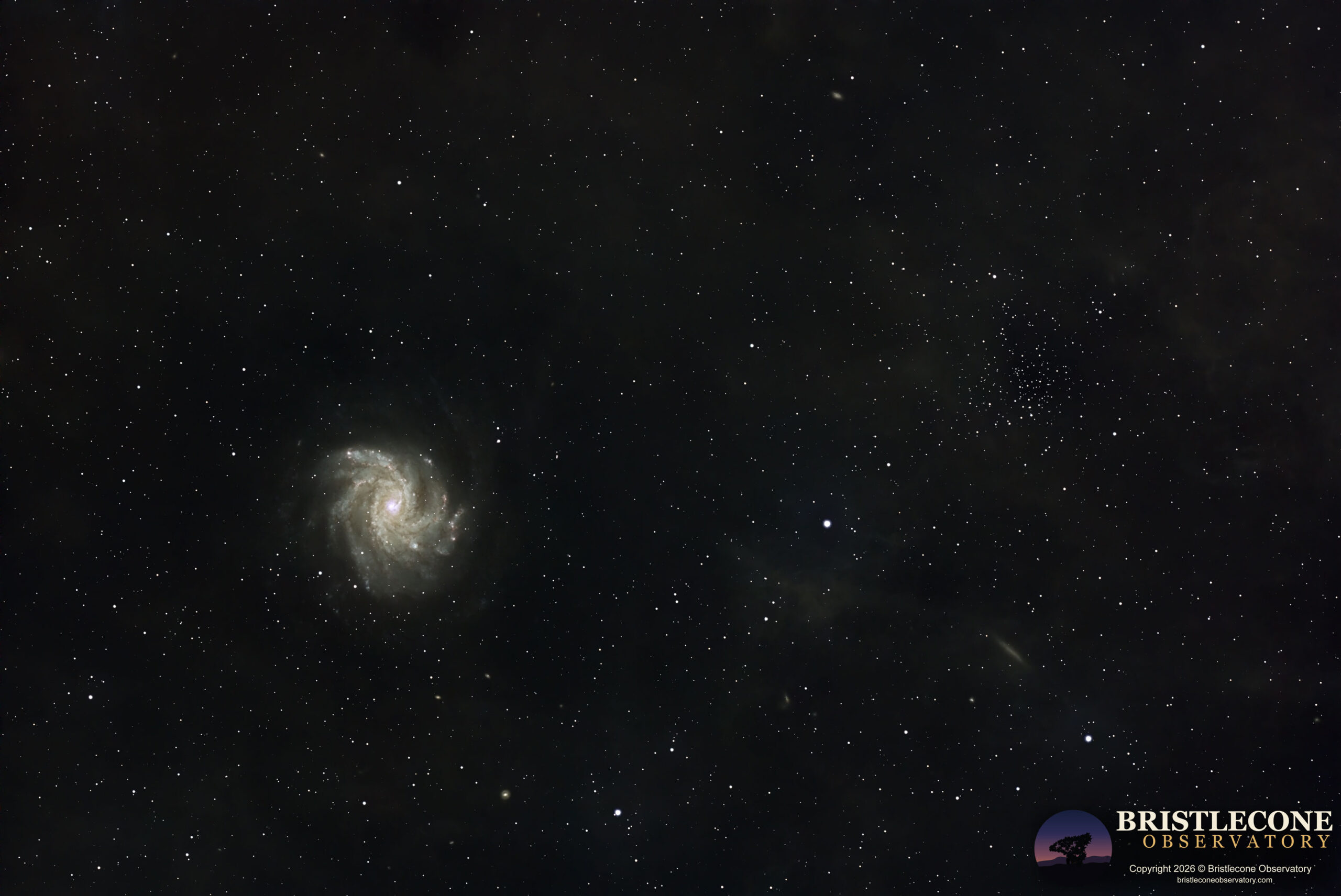
The Fireworks Galaxy (NGC 6946) is a spiral galaxy on the border of Cepheus and Cygnus, about 20 million light years away and roughly 40,000 light years across. It earned its nickname from its remarkable record of supernovae, with ten observed in the past century, more than almost any other galaxy. It is also an active star-forming galaxy, and its open spiral arms are dotted with pink hydrogen regions and young blue star clusters. The galaxy lies close to the plane of our own Milky Way, so dust and foreground stars dim its light and make it a challenge to image. At the upper right of this image is the open cluster NGC 6939, a collection of stars about 4,000 light years away. It is thousands of times closer than the galaxy, so the two only appear together by chance. NGC 6939 is also unusually old for an open cluster, at well over a billion years, so its stars have had time to drift into a rich, evenly spread field. The faint smudge just below the cluster is UGC 11583, a dwarf irregular galaxy that is probably a member of the Fireworks Galaxy’s small group, at a similar distance of roughly 20 million light years.