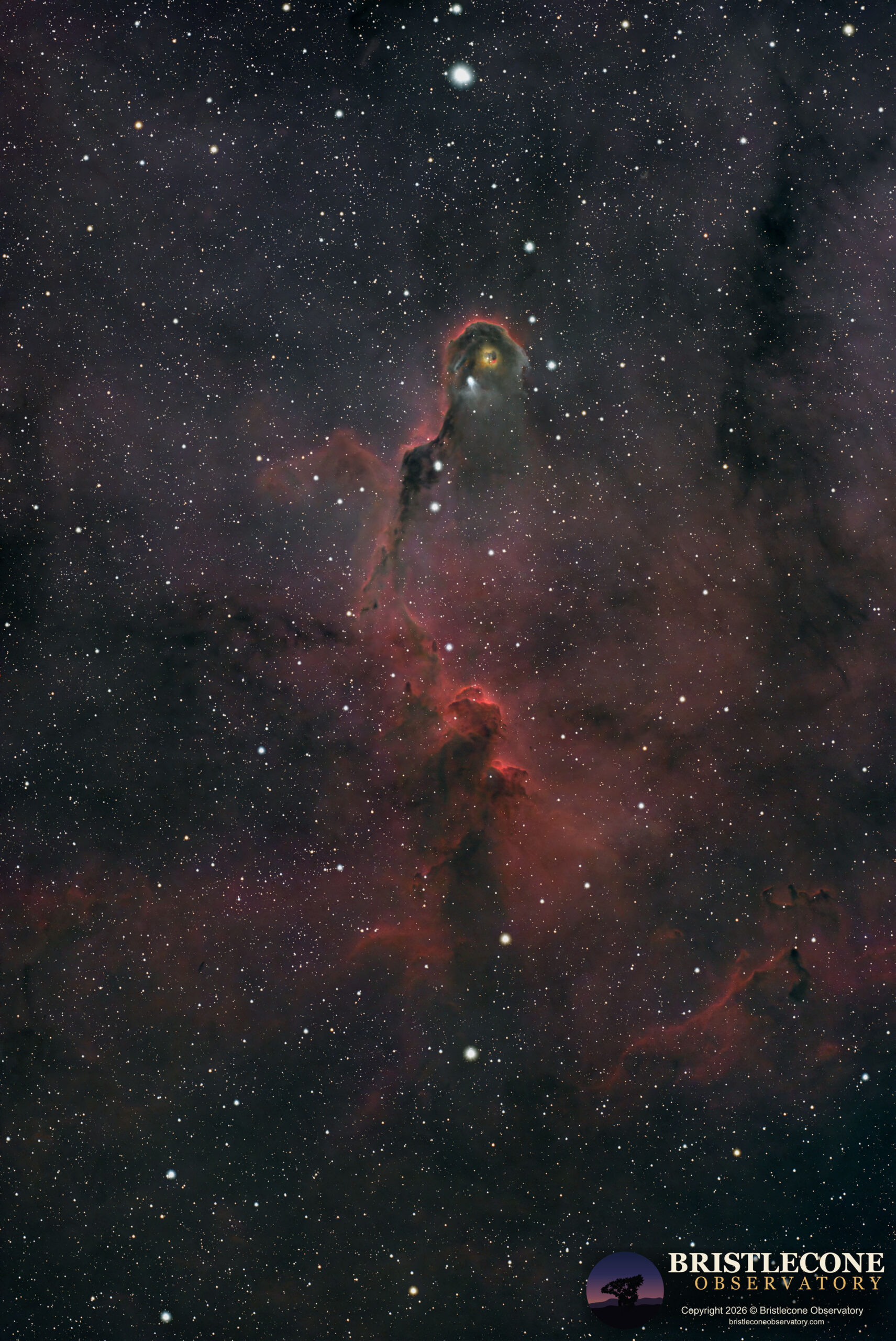
The Elephant’s Trunk Nebula, catalogued as IC 1396A, is a dark, winding cloud of gas and dust in the constellation Cepheus, about 2,500 light years away. It is a small part of the much larger emission nebula IC 1396, a vast region of glowing hydrogen that spans several times the width of the full Moon in the sky. The “trunk” itself is a dense globule roughly 20 light years long, and it earns its name from the curving shape that stretches down from a bright, rounded “head” at the top of this image. The surrounding gas is lit by a hot, massive star called HD 206267, whose intense ultraviolet radiation ionizes the hydrogen and makes it glow red while slowly eroding the edges of the dark cloud. That same radiation also compresses the dense interior of the trunk, triggering the birth of new stars. Infrared observations from the Spitzer Space Telescope have revealed young stars still forming inside, hidden from visible light by the thick dust. Over millions of years the globule will be gradually eaten away, leaving behind a cluster of newborn stars where the trunk once stood.