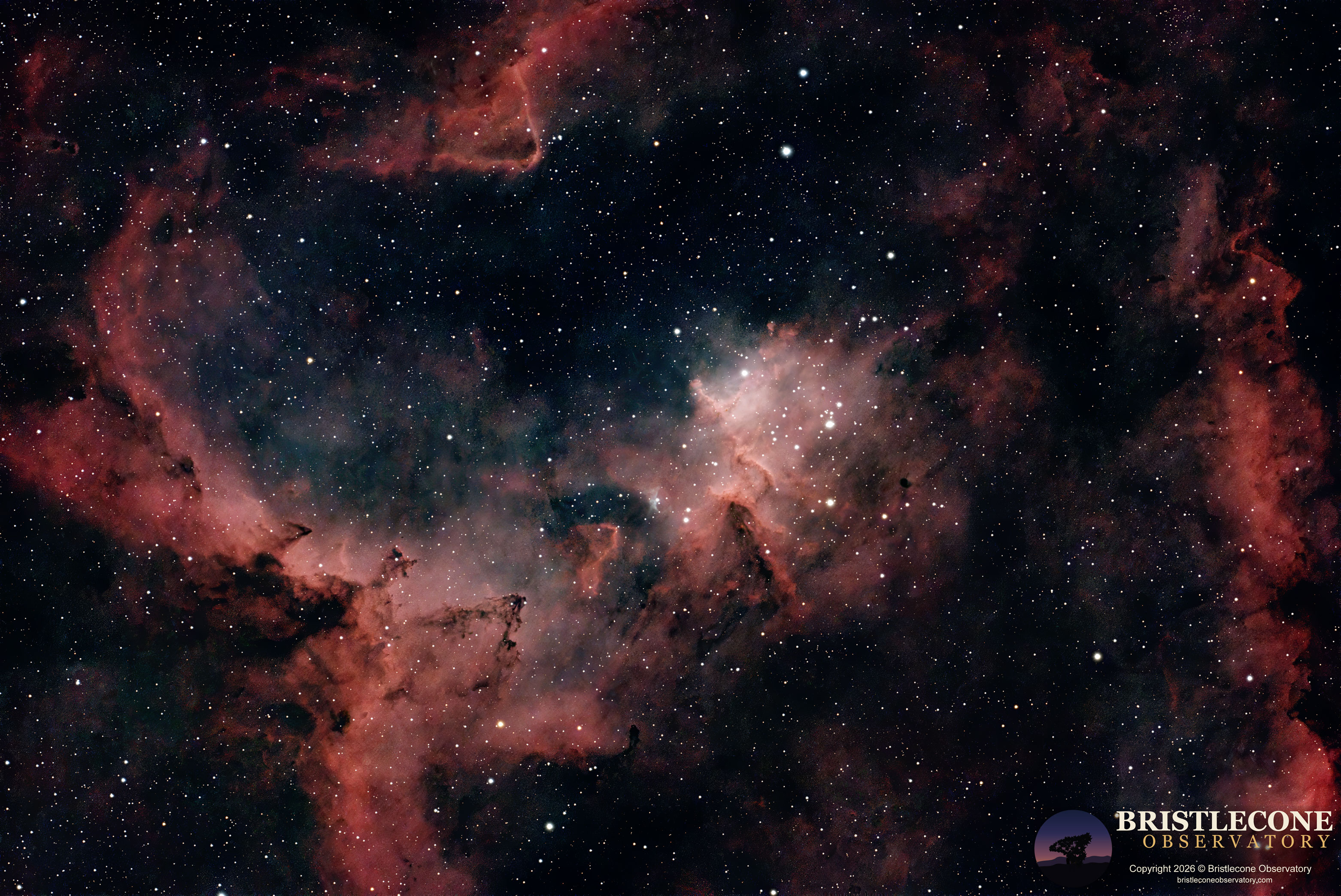
The central portion of the Heart Nebula (IC 1805), in the constellation Cassiopeia, is a glowing region of hydrogen gas about 7,500 light years away, and the heart-shaped outline of the full nebula spans more than 200 light years. At its core lies the young star cluster Melotte 15, which contains some of the most massive and luminous stars in the nebula. They are only a few million years old, and their intense radiation and stellar winds have carved out a hollow cavity in the surrounding gas. The same energy lights up the nebula’s characteristic red glow and sculpts the edges of the cavity into dark pillars and ridges of dust, which are visible in the lower center and left of this image. In these dense columns, new stars are forming even as the radiation of their older siblings slowly erodes the clouds that gave them birth.
This is an object I plan to revisit later. This was short run of about 25 exposures, and it really deserves a better effort.